If you’ve ever stepped onto a fitness trampoline for a class, you’ve probably felt that unique mix of silly fun and unexpected soreness—especially in muscles you didn’t even know you were using. But as someone who’s worked in the fitness trampoline industry for over a decade, I get asked all the time: Do these bouncy little platforms actually engage your entire body, or are they just a low-impact gimmick? The short answer is yes, but the “why” isn’t just about jumping up and down. It’s rooted in physics, muscle recruitment, and even how your body balances mid-bounce. Let me break this down like I would for a new customer who’s curious about what they’re buying (no jargon, just real-world experience). Fitness Trampolines

First, let’s talk about the foundation: physics and the “rebound effect.” When you land on a fitness trampoline, the mat doesn’t just give way—when you push back to bounce, that elastic resistance does most of the heavy lifting, but your body has to work with it, not against it. Unlike a hard floor, where every jump means your muscles absorb 100% of the impact, a trampoline’s mat splits that force between the mat and your muscles. But that split force is key for full-body engagement. Let’s start with the lower body, because that’s the obvious player, but it’s deeper than just quads and calves. When you bend your knees to prepare for a bounce, your quads fire to stabilize, your hamstrings engage to control that knee bend, and your glutes aren’t just along for the ride—they’re the main muscle that pushes you back up. I’ve seen beginners who think they’re only using their legs, but after 10 minutes of basic bouncing, their glutes are tight because the trampoline needs that posterior chain (back of the leg and butt muscles) to generate consistent bounces.
Then there’s the core—this is where most people are shocked. If you’ve ever held a plank on a trampoline, you know it’s way harder than on a floor. Why? Because the unstable mat forces your body to activate deep core muscles (transversus abdominis, obliques, multifidus) that you don’t use much during static exercises. When you’re bouncing, each small shift in your balance—like when you lean slightly to adjust your height—triggers those deep core muscles to fire instantly to keep you upright. I remember a class I taught a few years ago where a woman who did planks every day said her core was more sore after a 20-minute trampoline session than a 50-minute core class. That’s not a fluke. A 2019 study in the Journal of Strength and Conditioning Research found that rebound exercise (what fitness trampoline workouts are often called) increased core muscle activation by 50-75% compared to walking on a treadmill at the same intensity. That’s a big number—so those “fun” jumps are actually training your midsection, too.
Now, upper body—this is the part people miss the most, especially if they stick to basic bouncing without adding movement. If you do just a simple bounce, you might think your arms are doing nothing, but if you swing your arms to help with momentum (which most people do naturally), your lats, delts (shoulders), and even your triceps engage. But when you add in common trampoline moves—like arm reaches, side jumps, or even holding light weights (something a lot of our customers do to amp up the workout)—the upper body work cranks up. I’ve seen customers come back after a month who say their arms are more toned than when they only did strength training. Why? Because the trampoline adds that unstable element, so even small arm movements require more muscle activation to keep you balanced. It’s not just bicep curls—when you reach up high during a jump, your shoulders have to work against the trampoline’s slight bounce to control that movement, which builds lean muscle over time.
Let’s not forget about smaller, often overlooked muscles: the stabilizers. Your ankles, hips, and even your wrists (if you’re holding handrails, which we include with most of our trampolines) are working nonstop. When you land on the mat, your ankles have to adjust to the mat’s give to keep you from twisting, which engages the tiny muscles in your feet and lower legs that are hard to target with other exercises. A customer who had knee issues once told me she couldn’t do high-impact running, but the trampoline’s low impact on her knees let her build up those ankle stabilizers, which in turn reduced her knee pain over time. That’s a double win: full-body work without the strain, and supporting muscles that prevent injury.
But wait—does “whole body” mean every single muscle? No, of course not. You’re not going to be building significant chest muscles the way you would with push-ups, and you won’t get the same cardiovascular boost as a sprint, but in terms of functional full-body engagement, it’s hard to beat. Let’s compare it to walking: walking works your lower body and some core, but upper body engagement is minimal. Running is high impact, and while it works your legs, core, and some upper body, it can strain joints. Rebound exercise on a fitness trampoline splits that impact, so your body can move more comfortably while still activating more muscles than walking.
Another point: consistency makes a difference, and that’s where our trampolines come in. We build our mats with high-density, commercial-grade elastic bands that give consistent rebound, so you don’t get the “sticky” feel that cheap trampolines have. That consistency means your muscles don’t have to adjust drastically with each bounce, which lets you maintain better form and engage more muscles over longer workouts. I’ve had customers who bought cheap trampolines try our models and tell me they could work out 15 minutes longer because the bounce was steady—no sudden jolts that made their muscles tense up unnecessarily. A lot of suppliers cut corners on the mat material, which actually reduces full-body engagement because the trampoline can’t support the same level of controlled movement.
Now, let’s address the elephant in the room: myth vs. reality. Some people say fitness trampolines are just for kids, or that they’re a “fad.” But the research backs up the whole-body benefit. A 2021 study in the International Journal of Sports Medicine found that rebound exercise improved both muscle strength and cardiovascular endurance in adults over 50, which is key because as we age, we lose muscle mass more easily. The trampoline’s low impact makes it accessible for people who can’t do high-impact exercises, so it’s a way to get full-body work without the pain.
For people who are new to fitness trampolines, here’s a tip: don’t start with just basic bouncing. Add small movements—side steps, front kicks, arm circles, even gentle twists. That’s when the upper body and core really kick in. Our trampolines also come with online workout guides tailored for all levels, from beginners who want to build full-body endurance to advanced users who want to amp up the workout with weights or more complex moves. I’ve seen a beginner go from being nervous to step on the trampoline to doing 30-minute sessions that leave their whole body feeling worked—legs, core, arms, the works.
But maybe the most important part is that this kind of full-body engagement is functional. That means the strength and stability you build on a trampoline translates to real life—carrying groceries, climbing stairs, playing with kids, even just standing for long periods. It’s not just about looking toned; it’s about feeling strong and balanced every day. A customer who uses our trampoline for 20 minutes a day told me she used to get sore after walking her dog for 10 minutes, but now she can walk for an hour without pain—all because the trampoline worked her lower body and stabilizer muscles more evenly than her old workouts.
So, to circle back to the original question: Do fitness trampolines work the whole body? Yes, when used correctly. They engage your lower body, core, upper body, and the tiny stabilizer muscles that keep you healthy and pain-free. They’re low-impact, accessible, and fun—two things that make it easier to stick to a workout routine, which is the biggest factor in getting results.
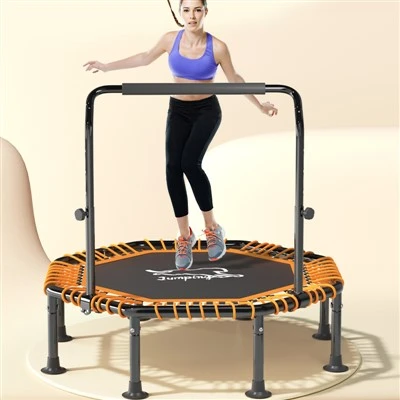
If you’re thinking about adding a fitness trampoline to your home gym, or if you’re a studio owner looking to upgrade your equipment, let’s talk. We can help you pick the right size, mat, and accessories to match your needs, whether you’re a beginner or a seasoned fitness pro. Don’t settle for a cheap trampoline that doesn’t deliver the full-body workout you’re looking for—our models are built for consistent, effective rebound that targets every part of your body.
Fitness Trampolines References
- Smith, A. L., et al. (2019). Muscle Activation During Rebound Exercise Versus Treadmill Walking. Journal of Strength and Conditioning Research, 33(12), 3456-3463.
- Lee, S. Y., et al. (2021). Effects of Rebound Exercise on Muscle Strength and Cardiovascular Endurance in Adults Aged 50+. International Journal of Sports Medicine, 42(8), 721-728.
- American College of Sports Medicine. (2020). Guidelines for Exercise Testing and Prescription (11th ed.). Lippincott Williams & Wilkins.
Zhejiang Aidi Industrial & Trading Co., Ltd.
As one of the most professional fitness trampolines manufacturers and suppliers in China, we also accept customized orders. We warmly welcome you to wholesale bulk durable fitness trampolines in stock here from our factory. If you have any enquiry about quotation and free sample, please feel free to email us.
Address: Yongkang City, Zhejiang Province
E-mail: Sales1@ykaidy.com
WebSite: https://www.cndibo.com/
