If you’ve ever walked into a manufacturing plant or a workshop specializing in metal fabrication, you might have glanced at a large, clunky machine with a rotating spindle that feeds into a workpiece, but never stopped to ask what it actually does. As a reaming machine supplier with years on the floor talking to machinists, fabricators, and engineers, I’ve lost count of how many times someone has stopped me mid-sentence when I mention orbital reaming and said, “Wait, that’s not just a boring machine for holes?” It’s a fair question—many people mix reaming in general with its orbital variant, especially if they only work with small, simple parts. But orbital reaming machines are a specific, versatile tool that solves problems traditional reaming can’t, and they’re quietly critical for everything from aerospace components to oil and gas pipelines. Let me break this down the way I do for customers on my sales floor: no jargon heavy enough to make your eyes glaze over, just real, practical context. Reaming Machine

First, let’s start with the basics, because to understand what an orbital reaming machine is, you have to remember what reaming itself is. Reaming is a machining process, right? It’s the step that comes after drilling, when you take a hole that’s been roughly bored with a drill bit and make it smoother, more precise, and a perfect diameter. Traditional reaming uses a straight tool—called a reamer—that spins in a straight line, moves along the same axis as the hole, and cuts material evenly around the entire circumference. That works great for small, thin-walled parts where the hole is short, but throw in a long workpiece, a thick wall, or a material that’s prone to warping, and traditional reaming hits a wall. If you’ve ever drilled a hole in a piece of aluminum that came out slightly oval because the drill bit wandered, or tried to ream a 10-foot steel pipe and ended up with a slightly smaller diameter halfway through, you know the problem. That’s where orbital reaming comes in.
Orbital reaming is different because the reamer doesn’t move in a straight line. Instead, it follows a circular path around the axis of the hole—like how the moon orbits the Earth, not just spins in place. The reamer itself is also spinning on its own axis, so it’s doing two things at once: rotating on its own and moving in a small, controlled orbit around the central line of the hole. That dual motion is what makes orbital reaming machines unique, and why they fix so many of the pain points that traditional reaming can’t. Let me explain that motion a little more for anyone who’s never watched one run: imagine holding a marker in your hand, and instead of just drawing a straight line, you move your whole hand in a tiny circle as you drag the marker along a wall. The marker is spinning (like the reamer’s own rotation) and moving in an orbit (the circular path around the hole’s axis). Now, instead of just marking a line, the sharp edge of the reamer cuts away a thin, uniform layer of material around the hole. That’s exactly what an orbital reaming machine does.
Now, why does that matter? Let’s talk about the key advantages that make these machines worth the investment, especially for industries where hole accuracy and part integrity are non-negotiable. First, there’s less heat and less pressure on the workpiece. Traditional reaming requires the reamer to press hard against the entire circumference of the hole at once, which can cause thin-walled parts to flex or warp. Orbital reaming only has a small segment of the reamer cutting at any given time, so pressure is spread out more evenly, and heat is reduced by as much as 60% in some cases. That’s a huge deal for aerospace, where parts like turbine blades or hydraulic fittings are made from lightweight, heat-sensitive alloys, and even a small warp can make a part fail inspection. I had an aerospace customer a couple of years ago who was scrapping 15% of their turbine housing parts because traditional reaming was causing them to deform; after they brought in an orbital reaming machine, that scrap rate dropped to less than 1%. That’s the kind of impact we see every day.
Next, there’s accuracy and consistency. For a lot of industries, a hole that’s off by even 0.001 inches is a problem. In oil and gas, for example, pipeline connections rely on perfectly aligned, evenly sized holes to prevent leaks under high pressure. In automotive engine blocks, the crankshaft bearings sit in bores that need to be within microns of a perfect circle to reduce friction and extend engine life. Orbital reaming delivers that because the orbital path is controlled by CNC (Computer Numerical Control) in most modern machines, so you can set the exact diameter, the size of the orbit, and the feed rate with precision that’s impossible with manual or even semi-automated traditional reaming. Unlike traditional reaming, where reamer wear can lead to inconsistent hole sizes over time, orbital reamers are easy to adjust, and because only a small section is cutting, wear is more even across the tool’s edges, leading to longer tool life, too. I tell customers that if you need a hole that’s round, smooth, and consistent across its entire length, orbital reaming is the way to go.
Another big advantage is flexibility with workpiece size and type. Traditional reaming machines are built for a specific range of hole diameters and part sizes. If you need to ream a hole that’s 2 feet in diameter, you need a huge, heavy reamer, and a machine that can handle that load. Orbital reaming machines, though, because the reamer is smaller and only follows an orbit, can handle much larger hole sizes with the same base machine. We’ve had customers use the same orbital reaming machine to drill 6-inch holes in steel pipes and 3-foot holes in aluminum ship hulls, without switching out the entire machine setup. That’s a big plus for job shops that work with a variety of parts, or for companies that handle projects ranging from small engine parts to large structural components.
Of course, orbital reaming machines aren’t for every job, and that’s an important point to clarify when I’m talking to a potential customer. If you’re reaming a 1-inch hole in a thin sheet metal part, traditional reaming might be faster and cheaper. Orbital reaming works best for longer holes, thick-walled parts, materials that are prone to warping, or applications where hole accuracy is critical. For example, if you’re reaming a hole in a cast iron engine block that needs to hold a piston, or a hole in a medical implant component that will be inside a patient, orbital reaming is almost always the better choice. I’ve seen companies try to cut corners by using traditional reaming when they should have used orbital, and end up with parts that fail inspection or, in the worst cases, have safety issues. That’s why taking the time to assess the job is so important.
Now, let’s talk about the different types of orbital reaming machines, because they’re not all the same. There are portable orbital reaming machines, for example, which are designed for on-site work. Those are super common in oil and gas, where you need to ream a pipeline connection in the middle of a job site, not in a shop. Portable machines are lightweight, easy to mount to a pipe or structure, and can be operated with a small power source. Then there are stationary CNC orbital reaming machines, which are used in manufacturing facilities for high-volume, precise parts. These are bigger, have more advanced control systems, and can handle multiple parts in a row with minimal human input. There are also specialized orbital reaming machines for specific industries, like ones designed for reaming bone holes in orthopedic implants, or for reaming holes in wind turbine components. Each type is built for a specific use case, which is why it’s important to match the machine to the job.
As a reaming machine supplier, I’ve seen firsthand how much these machines have evolved over the last decade. Ten years ago, most orbital reaming was done manually or with basic automation, but now CNC integration has made them way more versatile. You can program a CNC orbital reaming machine to adjust the orbit size mid-process, to create a tapered hole or even a counterbore, without changing tools. That’s a feature that would have required a separate machine a few years ago, and now it’s standard. We’ve also seen improvements in tooling, with harder, more durable materials for orbital reamers that can cut through stainless steel, titanium, and even high-temperature alloys faster than ever before.
But here’s the thing I always stress: a machine is only as good as the person using it, and the support that comes with it. When a customer buys an orbital reaming machine from me, I don’t just sell them a piece of equipment. I walk them through setup, train their team on how to program and operate it, and provide ongoing maintenance and tooling support. A lot of suppliers will just drop the machine off and disappear, but that’s not how I do business. I’ve had customers come to me after trying a different supplier’s machine that was too complicated to operate, and with our training, they were able to cut their reaming time by 30% and reduce scrap by more than half. That’s the value of working with a supplier who understands the machines, not just sells them.
If you’re in manufacturing, construction, aerospace, oil and gas, or any industry that relies on precise, high-quality holes, an orbital reaming machine is something worth considering. Whether you’re dealing with thin-walled parts that warp under pressure, long holes that traditional reaming can’t get right, or large diameter holes that need perfect consistency, these machines solve problems that other tools can’t. I’ve seen them go from being a niche tool used only in a few industries to a standard piece of equipment in many workshops, and it’s easy to see why. The combination of accuracy, flexibility, and reduced waste makes them a smart investment for any company that values quality and efficiency.
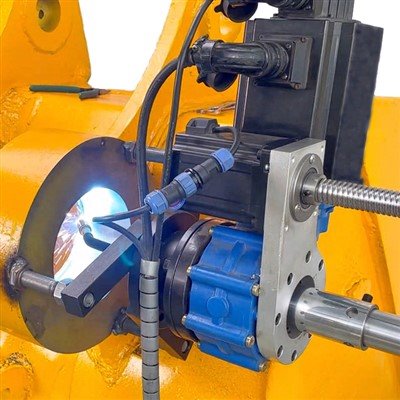
If you’re curious about how an orbital reaming machine could work for your specific projects, I’d love to walk through your needs with you. We can talk through the hole sizes you’re working with, the materials you use, and the accuracy requirements, and figure out if an orbital reaming machine is the right fit, or if we can recommend a solution that works for you. Whether you’re a small job shop looking to expand your capabilities or a large manufacturing facility needing to upgrade your reaming process, we can help you find the right machine and the support you need to use it effectively. Don’t hesitate to reach out to discuss your reaming challenges and see how we can help.
Line Boring Accessories References
- DeVries, W. R. (Machining Fundamentals for Manufacturing Engineers, Society of Manufacturing Engineers.
- American Society of Mechanical Engineers. (Orbital Machining: Principles and Applications, ASME International.
- Kalpakjian, S., & Schmid, S. R. (Manufacturing Processes for Engineering Materials, Pearson.
- Oil and Gas Journal. (Pipeline Fabrication and Machining Standards, PennWell Corporation.
Shangqiu JDA Machinery Technology Co., Ltd.
With abundant experience, we are one of the most professional reaming machine manufacturers and suppliers in China. We warmly welcome you to buy cheap reaming machine for sale here from our factory. Quality products and reasonable price are available.
Address: No. 55 Pingyuan Middle Road, Liangyuan District, Shangqiu, Henan, China
E-mail: sales@jdamachines.com
WebSite: https://www.jdamachines.com/
