If you’ve ever waited around for your Android phone to slowly top up at a café or on your nightstand, staring at the 1% ticking up like molasses, you know how frustrating standard wireless charging can be. If you’re in the market for a solution that cuts that wait time dramatically and works seamlessly with your Android device, a fast wireless charger is exactly what you’re looking for. As a wireless charger supplier that’s worked with Android device makers, repair shops, and retail partners for years, I’ve helped thousands of customers separate the hype from the real value of these chargers, and today I’m breaking down what makes them different, how they work, and why they’re a game-changer for anyone who relies on their Android. Wireless Charger
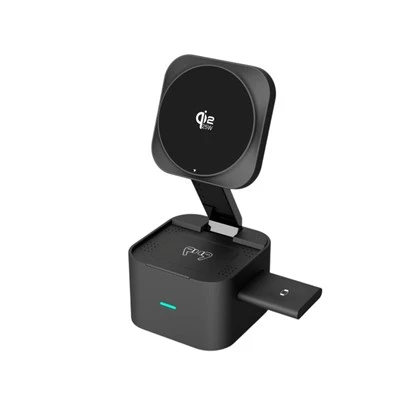
First, let’s start with the basics you probably already know: wireless charging, or inductive charging, is the process of transferring power between two coils—one built into the charger itself, and another embedded inside your Android phone. When you place your device on the charger, the coil in the charger creates an alternating magnetic field, which induces an electric current in the coil inside your phone, converting that current into power to charge its battery. A standard wireless charger, usually rated at 5W or 7.5W, works, but it’s glacial compared to what fast models deliver. Fast wireless chargers bump that power output way up, usually from 15W up to 45W or even higher, depending on your Android device’s compatible charging standard.
Here’s where it gets specific to Android: Android phones don’t all use the same fast charging tech—unlike some iPhone models that stuck to a single Qi standard for years, Android has standardized on two main systems, and a good fast wireless charger will support both, to work with almost every device out there. The first is Qi, the global standard for wireless charging, used by most Samsung Galaxy, Google Pixel, OnePlus, and LG phones. The other is the proprietary fast charging tech many Android brands developed for their wired chargers, like Samsung’s Adaptive Fast Charging (AFC), OnePlus’s Warp Charge, and Google’s Pixel Stand fast charging. A quality fast wireless charger will bridge these, so you don’t have to buy a separate charger for your Galaxy S24 and your Pixel 8.
Now, let’s talk about the real difference in speed, because that’s what matters most. A standard 5W wireless charger might take 3 to 4 hours to fully charge a mid-range Android battery (which is usually around 4,500 mAh these days). A fast wireless charger rated at 25W will cut that time in half—so you get a full charge in 90 minutes or less. For high-end Android phones that support 45W fast wireless charging, you can often get a 50% charge in just 20 minutes, and a full charge in under an hour. I remember last year, a regular customer who runs a chain of phone repair shops told me they used to hand out 5W chargers as free swag for people who came in with dead phones, but once they started carrying our 25W fast wireless chargers, they sold 10 times more of them. The reason? A customer would come in with a dead Samsung Galaxy S23, wait 10 minutes in line, place it on the fast charger, and by the time they were done checking out, their phone had 30% charge. That’s the kind of value that sticks.
But fast wireless charging isn’t just about raw wattage—there’s a lot more that goes into making a charger actually work well for Android. One thing I see a lot of suppliers skip is thermal management, and that’s a big deal. When you push power through a charger and a phone, heat builds up, and if there’s no good way to dissipate that heat, it can slow down charging to protect the phone’s battery, or even cause damage over time. Cheap fast chargers often get too hot, leading to throttling, which means you end up with charging speeds no better than a standard charger. At our company, we design every fast charger with built-in temperature sensors and passive heat sinks (or small fans for higher-wattage models) to keep temps low, so you get consistent fast charging from start to finish, not just the first 10 minutes. We test every charger with a range of Android devices—from a budget Moto G Power to a flagship OnePlus 12—to make sure the charging speed stays steady, not drops off halfway.
Another key feature for Android users is alignment convenience. A lot of fast chargers, especially older models, require you to place your phone perfectly centered over the coil, which can be a hassle if you’re trying to set it down while holding a coffee or scrolling. Many modern fast wireless chargers for Android have wider coils, or multiple coils, so you can set your phone at any angle—whether it’s face-up, face-down, or even propped up in a stand—and it will still charge fast. We also make stand-style fast chargers that let you use your phone while it charges, which is perfect for watching Netflix, taking video calls, or checking your phone while you work at a desk. I’ve heard so many customers say they hate having their phone flat on a charger, unable to use it, and a good fast stand fixes that without slowing down charging.
Wait, but can you use a fast wireless charger with any Android phone? That’s a common question, and the short answer is: most, but you have to check compatibility. Every Android phone released after 2018 (with a few budget exceptions) supports at least 15W Qi fast wireless charging. If your phone is older, you might need a Qi receiver accessory to add wireless charging capability. Even if your phone supports wireless charging, though, some older models max out at 10W, so a 25W charger will still work, it just won’t charge faster than your phone’s maximum. That’s why we always recommend that customers check their device’s charging specs first—our product pages list compatible devices, and our support team can help you figure out which charger will work best for your phone.
I should also clear up a common myth: a fast wireless charger won’t damage your Android’s battery, as long as it’s a quality charger designed for fast charging. A lot of people worry that high wattage will wear out the battery faster, but modern chargers and phones have built-in safety features that regulate power delivery. When your battery is fully charged, the charger will switch to trickle charging to keep it topped off without overcharging, and temperature sensors will shut down fast charging if things get too hot. Cheap, uncertified chargers that don’t have these safeguards can cause damage, but a reputable fast wireless charger from a reliable supplier like ours is designed to work with your phone’s battery management system to keep it safe for thousands of charge cycles.
Now, let’s talk about real-world use cases, because that’s where fast wireless chargers shine. If you’re a commuter, a small fast charger for your car lets you charge your phone while you drive, without fumbling with a cable, and you’ll get enough charge in a 30-minute commute to last through the rest of your day. If you work from home, a fast charger on your desk means you never have to hunt for a cable when your phone dies mid-meeting. For parents, a fast charger on the kitchen counter means the kids can place their tablets or phones on it, and they’ll be ready to go when they leave for school or practice. Last month, a teacher bought 15 of our 15W fast wireless chargers for her classroom, so students who forgot their chargers could top up their phones between classes—she told me it cut down on the number of students asking to borrow hers by 90%.
As a wireless charger supplier, we’ve seen the shift in what Android users want over the past few years. Five years ago, most people were happy to just have any wireless charger that worked. Now, they want speed, convenience, and reliability that works with their specific Android device. We don’t cut corners on materials—our chargers use durable silicone pads that prevent scratches, and non-slip bases that keep your phone from sliding off even if you bump the table. We also offer different sizes, from tiny portable fast chargers you can slip in your pocket, to 3-in-1 chargers that work for your phone, smartwatch, and earbuds all at once.
If you’re tired of waiting hours for your Android to charge, tired of tangled cables, or tired of chargers that stop working after a month, a fast wireless charger is the solution you’re looking for. It’s not just a luxury accessory—it’s a practical tool that saves you time, reduces clutter, and works with the devices you already own. Our team has tested hundreds of chargers to make sure ours stand up to daily use, and we work with you to find the right model for your needs, whether you’re a small business buying in bulk, a parent buying for your family, or someone looking to upgrade their home setup.

If you’re ready to learn more about our fast wireless chargers, see the full range of models, or discuss bulk ordering for your business, get in touch with our team to schedule a conversation. We’re here to answer any questions you have about compatibility, speed, safety, or anything else, and we’ll help you find the perfect charger for your Android device.
Multifunction Power Bank References
- Federal Communications Commission. (2022). Inductive Charging for Mobile Devices: Technical Overview and Safety Standards.
- International Organization for Standardization. (2021). ISO/IEC 14543-3-10: Wireless Power Transfer for Consumer Electronics.
- Samsung Electronics Co., Ltd. (2023). Galaxy S24 Series Charging Specifications: Wired and Wireless Power Delivery.
- Google LLC. (2023). Pixel 8 Wireless Charging Performance and Safety Guidelines.
- Wireless Power Consortium. (2022). Qi Specification v1.3: Fast Charging Extensions for Android Devices.
KOMOS Co., Ltd.
As one of the most professional wireless charger manufacturers and suppliers in China, we are committed to providing high quality custom service and OEM service. Please feel free to wholesale bulk durable wireless charger at competitive price from our factory. Welcome to contact us for quotation.
Address: 4th Floor, Building 3, Zhongxi Buchong Community, Shajing Street, Bao’an District, Shenzhen City, Guangdong Province, China 518104
E-mail: contact@komos-tech.com
WebSite: https://www.komos-tech.com/
