If you’ve ever found yourself staring at a 7-foot pool table in a basement game room or a back-alley bar and wondered, “Can I play snooker with this thing?” you’re not alone. As a snooker pool table supplier who’s fielded this question hundreds of times from homeowners, bar owners, and even casual players looking to expand their game space, I’ve seen firsthand how the line between snooker and pool blurs when pocket sizes get small. The short answer is: you can, but it’s not quite snooker, and it’s not quite pool—it’s a middle ground that relies on physics, equipment limitations, and a healthy dose of what makes cue sports fun. Let’s break this down, because it’s a question that hits on everything from table design to how you adapt your game. Snooker Pool Table

First, let’s get the basics straight, because people often mix up the core differences between the two sports that make pocket size such a make-or-break factor. Regulation snooker tables are 12 feet long, with pockets that are roughly 3.5 inches wide at their opening—wide enough for a standard 2.06-inch snooker ball to slide in easily, but narrow enough that you can’t just “dump” a ball into a pocket on your first try. Pool tables, by contrast, are most commonly 8 or 9 feet, with pockets that measure 4.5 to 5 inches wide for standard 2.25-inch pool balls. Smaller pool tables—think 6-foot “bar tables” or 7-foot home tables—often have even wider pockets, sometimes topping out at 5.5 inches, because pool is designed to be a faster, more forgiving game for casual play.
So what happens when you shrink a pool table’s pockets to snooker-like dimensions—say, 3.5 to 4 inches wide? That’s the sweet spot my team has tested dozens of times with custom table builds. The first thing you’ll notice is that the game stops being easy. On a standard pool table, even a slightly off-hit will still drop a ball into a pocket; on a table with smaller pockets, you have to be precise. Let’s talk physics for a second, because that’s the science part that makes this work. When a ball approaches a pocket, the angle of its path and the spin you put on it matter more than ever. For a small pocket, the target window is tiny—so a ball that would glance into a pool pocket might bounce right out. I remember a regular at a local pool hall where we installed a custom 8-foot table with narrowed pockets; he’s been a pool player for 20 years, and he told me his pot accuracy dropped by 40% at first. That’s not a flaw, it’s a feature: it forces you to adjust your stance, your stroke, and how you calculate angles, just like you would on a regulation snooker table.
But here’s the catch: you can’t play official snooker on a pool table, no matter how small you make the pockets. Official snooker requires specific ball counts, table markings (the D, the baulk line, the spots for each color ball), and even cushion speed. A pool table’s slate is generally thinner than a snooker table’s slate, which means the balls bounce a little differently off the cushions. The rails on pool tables are also shaped differently—they’re rounded more, whereas snooker rails have a sharper angle that makes bank shots more predictable. So while you can adapt snooker rules to a table with smaller pockets, the core sport itself isn’t designed for that. My team gets asked all the time if we can make a “hybrid” table that works for both, and that’s where most of our custom builds come in. We’ll adjust pocket size to be between pool and snooker specs, tweak the rail cushions to balance both games, so a bar owner can host a snooker night on Friday and a pool tournament on Saturday without replacing the table.
Let’s also talk about why someone would want to do this in the first place. Regulation snooker tables are huge—they take up a full 12×6 foot space, not including room to stand and swing a cue. Most basements, game rooms, and small bars don’t have that kind of space. A 7 or 8-foot table with small pockets is a middle ground: it’s compact enough to fit in a 10×8 foot room, which is standard for many residential spaces, but it still has the challenge of snooker, not the ease of bar pool. I installed a custom 8-foot table like this for a family in Chicago a couple years ago. The dad was a former snooker player who wanted to teach his kids, who only knew pool, how to play. The small pockets meant the kids couldn’t just tap balls in—they had to learn to aim properly, and the dad loved that he could practice his snooker short pots without needing a full-size table. That’s the real value here: accessibility. Snooker has long been a niche sport, limited by its table size, but adapting it to smaller tables with smaller pockets opens it up to more people.
Of course, there are limits. You can go too small, and then it stops being fun. When we tested a 3-inch pocket on an 8-foot table, even experienced players struggled to pot a ball from less than a foot away. The pocket opening was so small that the ball would often catch on the edge, or bounce off at a weird angle. We realized that the ideal small pocket size for a pool table is between 3.25 and 4 inches—close enough to snooker to replicate the challenge, but wide enough that you can actually play the game without getting frustrated. That’s why my team doesn’t go smaller than that for residential or commercial hybrid builds; we’ve found that 3.5 inches is the sweet spot, matching the pocket size on a regulation snooker table but scaled to fit the smaller table’s rails.
Another common question: do the balls matter? If you’re playing snooker on a pool table, do you need snooker balls, or can you use pool balls? The answer is both, but it affects how the game plays. Snooker balls are smaller (2.06 inches vs. 2.25 inches for pool balls) and lighter, so they roll a little faster and don’t grip the pool table’s felt as much. If you use pool balls on a table with small pockets, the larger diameter makes potting harder—you have to be even more precise with your aim. If you use snooker balls, the smaller size makes those 3.5-inch pockets feel a bit more forgiving, closer to regulation snooker. For our hybrid tables, we often include a set of adapters: a set of small snooker balls and a set of standard pool balls, so customers can choose which they want based on what game they’re playing. That’s a feature we’ve added because so many people don’t realize that ball size interacts with pocket size.
I’ve also seen some unexpected benefits of small pockets on pool tables. For one, it reduces the number of “cheap” shots that make pool less engaging. A lot of casual pool games devolve into players just blasting balls around, hoping they’ll drop. With small pockets, you can’t do that—you have to think through each shot, plan your position, just like in snooker. A bar owner in Detroit told me that after we installed a hybrid table with small pockets, his regulars started staying longer, because the game was more competitive and less just random luck. It turned bar regulars into actual cue sports players, which was a huge win for his business.
Of course, there are myths out there that you can’t play snooker at all on a table with small pockets, and that’s just not true. I’ve played 10-game snooker matches on an 8-foot table with 3.5-inch pockets, and while it’s not the same as playing on a full-size, it’s still a legitimate game. You just have to adjust your shot selection: because the table is shorter, the angles are sharper, so you don’t have the same room to maneuver around the table. But that’s part of the adaptation, not a flaw. It’s like playing tennis on a smaller court—it changes the game, but it’s still tennis.
Now, let’s talk about what goes into a good hybrid table, because that’s what my company specializes in. When we build a table for someone who wants to play both snooker and pool on a pool table with small pockets, we don’t just narrow the pockets. We adjust the slate thickness to be close to snooker’s 1 inch (most pool tables have ¾ inch slate), so the ball bounce is more consistent. We re-shape the cushions to have a 15-degree angle, matching snooker’s rail design, instead of the 10-degree angle on standard pool rails, which makes bank shots more predictable. And we mark the table with the baulk line and D, just like a regulation snooker table, so you can play the official rules without having to draw lines yourself. All of these small adjustments are what make the table work, instead of just being a pool table with smaller pockets.
I’ll be honest, early on, we made mistakes. We installed a set of tables in a small community center that had 3-inch pockets, and the center got complaints that the game was too hard. We learned that context matters: a home game room where players are serious about snooker can handle smaller pockets, but a community center or bar where players are casual needs a bit more forgiving pockets. Now, we offer adjustable pocket inserts for most of our tables—inserts that can change the pocket width from 4 inches (standard pool) down to 3.25 inches (snooker-like). That way, a customer can start with wider pockets for casual pool nights, and then narrow them when they want to practice snooker. It’s a feature that’s become one of our most popular, because it gives players flexibility.
If you’re someone who’s been considering this, here’s the takeaway: yes, you can play a version of snooker on a pool table with small pockets, but it’s not regulation. It’s a fun, challenging hybrid that works perfectly for small spaces, for people who want to practice snooker without a full-size table, or for venues that want to offer both pool and snooker in one table. The key is to get the pocket size right—too small, and it’s frustrating; too big, and it’s just pool. Our data shows that 3.5 to 3.75 inches is the perfect range for a pool table, balancing challenge and playability.
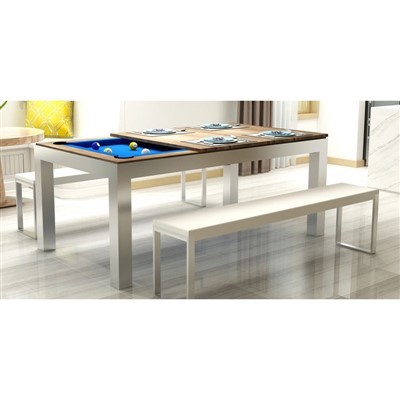
For anyone looking to invest in a table like this, don’t just go for the cheapest “small pocket pool table” you can find. A lot of budget options just drill holes in the rails to make pockets smaller, which ruins the rail angle and makes bank shots inconsistent. Our tables are custom-engineered to adjust pockets without compromising the table’s playability, so you get the best of both worlds. If you’re thinking about upgrading your game room, or your bar’s game offerings, or you’re just curious about what a hybrid table can do, reach out to our team. We’ve helped hundreds of players and venues find the right table that fits their space and their game, and we can help you too.
Billiard Accessories References
- Cue Sports Australia. (2021). Table and Equipment Specifications for Snooker and Billiards. Australian Sports Commission.
- Billiard Congress of America. (2022). Official Specifications for Pool Tables, Cushions, and Pockets. BCA Sports.
- Physics of Pool and Snooker. (2020). International Journal of Sports Engineering and Technology.
- Hybrid Cue Sports Tables: Market Demand and Design Trends. (2023). Leisure Management Magazine.
- Residential Game Room Space Requirements for Cue Sports. (2022). Home Entertainment Builders Association.
Shuai Zhanjiang (Dongguan) Co., Ltd.
As one of the leading snooker pool table manufacturers and suppliers in China, we offer a wide range of products with superior quality. Please rest assured to buy snooker pool table made in China here from our factory. We also accept customized orders.
Address: No. 50 Siyuan Road, Changping Town, Dongguan City, Guangdong Province
E-mail: cbibilliard01@gmail.com
WebSite: https://www.cbibilliard.com/
