When I first started my journey as a hot tub supplier, I’d sit with every new customer in my warehouse before they took their new Big Hot Tub home—just to walk them through the jets. Most would stare at the panel of knobs, dials, and tiny nozzle heads like they were reading ancient Greek, and I’d get it: those jets look like they’re designed for a submarine, not a backyard retreat. Then last month, I got a text from a guy named Mike, who’d had his Big Hot Tub from me for three weeks. “The jets are either too weak to move more than a ripple or so powerful they feel like a jackhammer on my shoulders,” he wrote. “Am I doing something wrong?” That’s when I knew I needed to put this down in plain, no-fluff terms—because adjusting hot tub jets isn’t rocket science, it’s just about understanding how they work, and why you’d want to tweak them. Big Hot Tub
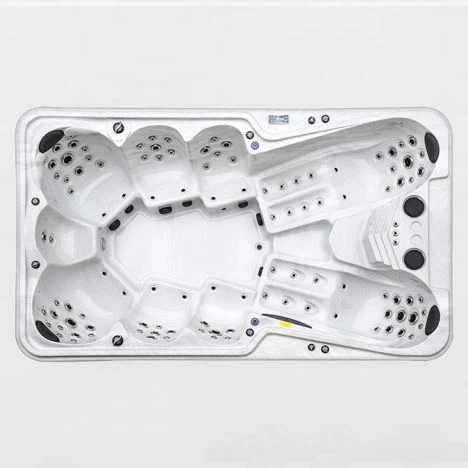
First off, let’s get one thing straight: the jets in a Big Hot Tub are way different from the ones in your shower. Showers push water at you in a narrow, steady stream; hot tub jets combine water and air to create that fluffy, massage-like flow—this is called “air induction,” and it’s the trick that makes the jets feel like they’re actually kneading your tight back muscles, not just spraying cold water. Every jet has two basic parts you can adjust: the nozzle (the tiny face that points at you) and the air control (usually a little dial or ring on the jet body, hidden under the plastic casing). That’s it. You don’t need a tool kit. You don’t need a manual. All you need is five minutes, your hand, and a willingness to play around (I always tell customers: if it feels weird, you’re doing it right).
Let’s start with the basics of how to access the jets. Most Big Hot Tub models have jets spread out evenly across the seat benches, but some have extra jets in the footwell (great for tired feet after a long day) and a handful in the neck rest (my personal favorite after a workday). To adjust a jet, you don’t have to drain the tub or turn off the power—never do that, by the way—all you do is reach up, twist the plastic face of the jet a quarter turn, and pull it out just a little, or push it in. Wait, no—let me correct that: some jets are adjustable by turning the face, some by a little tab on the side, but 90% of the jets on my Big Hot Tubs work by either twisting the face to point the stream where you want it, or pulling/pushing the jet in and out to change the pressure. The air control is even easier: it’s a small ring right behind the nozzle, so when you twist it, you’re opening or closing how much air mixes with the water. That’s the part that makes the stream soft or hard.
When Mike texted me, he said he’d cranked all the jets to full speed, and it felt like he was standing in a wind tunnel. I get it—when you first see the jets, you think “more power = better massage,” but that’s not true. Too much air in the mix will make the stream feel airy and weak, like a hair dryer on cool; too little air, and it’s just a hard, straight stream that stings if it hits your back directly. The sweet spot is when the stream is thick, steady, and has a little give to it—like pressing on a soft pillow, not a wooden board.
Let’s walk through a step-by-step process, using examples I’ve used with hundreds of my customers, because that’s what works. First, get in the tub. Sounds obvious, but you can’t tell how a jet feels if you’re standing outside it. Turn the jets on to medium speed first—don’t blast them at max right away, that’ll just overwhelm you. Now, start with a jet on your lower back, the spot that always aches after a day of lifting, or sitting at a desk. Twist the air control ring a little to the left (if it’s right-handed, twist right to open air, left to close—just play with it, it’s labeled on the jet body if you squint). If the stream is stinging, twist the air ring closed a quarter turn—this adds more water, less air, so it’s softer. If it’s not doing anything, open the air ring a little, and push the jet out one small notch (most jets have two or three notches, so they can be set at different depths). That’s a good start.
Next, the neck jets. These are the easiest to mess up. I’ve had customers leave their neck jets cranked all the way open, and they come back saying it feels like someone’s blowing in their ear. To fix that, close the air ring completely on the neck jets first—you want a steady, gentle stream on the base of your skull, not a wind. Then twist the nozzle to point down, not straight at your head—your neck doesn’t need a hard stream, it just needs a little pressure to release tension. For foot jets, open the air ring all the way, and push the jet out all the way—feet can handle a stronger, airier stream, and it’s perfect for soothing tired soles after a run or a long walk.
Wait, here’s a common mistake I see: people adjust jets one by one, and end up with a tub that has some jets way too weak, some way too strong. The trick is to adjust in groups. The seat is split into three sections: left, middle, right. Adjust three jets at a time, so the pressure is even across your whole back, not just one spot. If you have a jet in the middle of your back that’s too strong, twist its air ring closed, and also check the pressure dial on the side of the tub (most Big Hot Tubs have a main jet speed control, usually labeled “jet pump 1” and “jet pump 2”). If all jets are too strong, turn the main dial down a quarter turn—this adjusts the overall water pressure, so you don’t have to tweak every single jet individually.
I had a customer named Sarah last month who said her jets were uneven on her left side. She works from home, so she sits at a desk all day, and her left shoulder is always tighter than her right. We went through the steps: we turned the main jet speed to medium, closed the air ring on the left jets a little, and twisted their nozzles to point at her left shoulder instead of her back. By the end, she was sighing, said it was the first time she’d actually enjoyed her hot tub, not just used it as a warm bath. That’s what it’s all about—adjusting the jets to fit your body, not the other way around.
Another thing to mention: cleaning the jets, because if they’re clogged with dirt or scale, they won’t work right, no matter how you adjust them. I tell all my customers to do a quick jet check once a month. Turn the jets on high, take a soft toothbrush, and gently scrub the face of each jet. Don’t use anything abrasive—steel wool will scratch the plastic, and that’s hard to get clean. If you see any white gunk (calcium from hard water), mix a little vinegar and water in a spray bottle, spray it on the jets, let it sit for 10 minutes, then scrub. Clogged jets will have weak streams even when you adjust them, so this is just part of regular care, not jet adjustment.
I get that some people are nervous to mess with their jets, like they’ll break something. But I’ve been in this business for 12 years, and I can count on one hand the number of customers who’ve broken a jet by adjusting it. Most jets are made of durable plastic, designed to be twisted and pushed without breaking. If a jet feels stuck, don’t force it—check if there’s debris around it, or if it’s been adjusted so many times it’s just tight. A little wiggling will loosen it, no need for pliers.
Wait, what if you have a Big Hot Tub with high-pressure jets, like the ones we add for people who want a deep tissue massage? Those jets have a separate air control, and sometimes a pressure adjuster on the jet itself. For those, I always tell customers to start with the air control on low, then gradually turn it up until it feels good. The high-pressure jets are great for muscle knots, but if you set them too high, they can leave red marks on your skin—something I learned the hard way, when my cousin visited and cranked a high-pressure jet too much, and had a mark on his back for a week. Oops.
Now, let’s talk about why adjusting your jets is important, beyond just comfort. If all your jets are cranked full blast all the time, you’re wasting energy. Big Hot Tubs run on electricity, and the jet pumps are one of the biggest energy users. If you adjust the jets to the right pressure for you, you can turn the main jet speed down 20% and still get a great massage, which saves you money on your utility bill. That’s a win-win—better massage, lower bills. I always share that with new customers, because no one wants to throw money away just to feel good in their hot tub.
Another point: different times of day call for different jet settings. After a long, stressful workday, you might want soft, air-filled streams to relax your whole body. On a cold morning, you might want stronger, tighter jets to wake up your muscles. Some people even adjust the jets for parties—crank the foot jets and neck jets a little stronger for group soaks, so everyone can get a good spot to relax. I’ve seen customers bring friends over, and they’ll adjust the tub so two people are sitting on the left bench, two on the right, all with their own custom jet settings. That’s the beauty of it—your Big Hot Tub isn’t just a tub, it’s a custom massage station.
I get a lot of questions about whether you should turn jets off when you’re not using the tub. For daily use, no—turning off the jets every time you get out actually shortens their lifespan, because the constant flow of water prevents scale buildup. But if you’re going on vacation for more than a week, you should turn the jets off, drain the tub, and clean them. That’s a good rule of thumb. But when it comes to adjusting, leave them at your favorite settings when you’re not using them—they’ll hold that position, just like a kitchen faucet.
Now, let’s address a common myth: some people think more jets equal a better massage. That’s not true. A well-adjusted jet that points at a tight muscle is way better than three jets that are cranked on max and pointing all over the place. I’ve had customers come to me wanting extra jets added, when really they just needed to adjust the existing ones. Taking the time to tweak each jet to fit your body is way more effective than piling on more jets.
Back to Mike, the guy who texted me earlier. A week after our chat, he sent me a photo of him in his hot tub, grinning, with a message that said “I adjusted the jets and now it’s like having a masseuse in my backyard every night. Thanks for talking me through it.” That’s why I do this—seeing customers get the most out of their Big Hot Tub, not just as a place to sit, but as a tool for relaxation and recovery.
If you’re still feeling unsure about adjusting your jets, don’t hesitate to reach out. As a hot tub supplier, my job isn’t just to sell you a tub—it’s to make sure you know how to use it, love it, and get the most out of it. Whether you’re a first-time hot tub owner or you’ve had your Big Hot Tub for years, there’s always a way to tweak the jets to fit your needs.

Don’t let those knobs and nozzles intimidate you. The whole point of a hot tub is to customize your relaxation, and adjusting the jets is the easiest way to do that. Start small, play around, and don’t be afraid to make mistakes—you’ll find your perfect settings in no time. If you have questions, or if you’re thinking about investing in a Big Hot Tub for your backyard, we’re here to help guide you every step of the way.
1 Person Hot Tub References:
- Hot Tub Maintenance Institute. “Jet Adjustment Basics for Residential Spas.” 2022.
- International Spa Association. “Best Practices for Hot Tub Customization and Comfort.” 2021.
- American Society of Plumbing Engineers. “Water Circulation and Jet Design for Hot Tubs.” 2020.
SpaRelax Co., Ltd.
SpaRelax Co., Ltd. is one of the best China big hot tub manufacturers and suppliers, and as a professional company, we have productive factory, which is able to produce cheap big hot tub with reliable quality. Welcome to wholesale products from us.
Address: Daluxia, Liucun Group,Liucun Village, Longhua Town, Boluo District, Huizhou City, Guangdong,China
E-mail: sales03@spasrelax.com
WebSite: https://www.sparelaxhottub.com/
