If you’ve ever installed a solar power system and noticed your MPPT charge controller running hotter than you’d expect—warm to the touch is normal, but sweltering enough that you have to step back when you reach it—that’s a problem. As a MPPT solar charge controller supplier, I’ve spent hundreds of hours troubleshooting these units with installers, hobbyists, and even residential solar owners, and overheating is one of the most common (and preventable) issues we get asked about. Let’s break down why this happens, what you can do about it, and how to avoid it in your next system. Mppt Solar Charge Controller
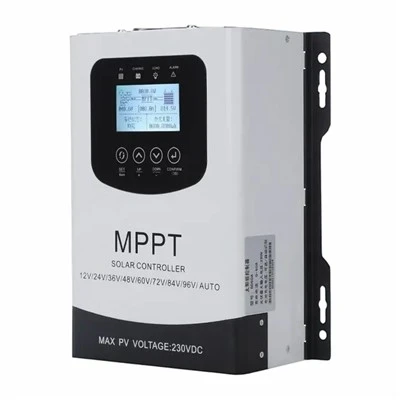
First, it’s important to set a baseline: MPPT charge controllers work by adjusting the electrical load from your solar panels to maximize power transfer, a process that involves switching high currents on and off rapidly. That switching action generates a small amount of heat as a byproduct of electrical losses—no unit is 100% efficient, and a 1% loss in a 100A controller translates to 10 watts of heat, which will raise the unit’s temperature slightly. But when that heat builds up beyond safe operating limits (most MPPT controllers are rated to handle up to 60°C / 140°F continuously, with damage occurring around 85°C / 185°F), there are specific, fixable causes.
One of the biggest culprits is undersizing the MPPT controller for your solar array. I can’t tell you how many times we’ve supported a customer who bought a 30A MPPT unit to pair with a 450W solar panel array. Let’s do the math: a 450W panel at peak sun (1,000 W/m²) outputs around 37.5 volts, and the short-circuit current for a typical 450W panel is about 12.25 amps. If you have four of those panels wired in series, you’re looking at 150V open-circuit voltage, and if wired in parallel, you’d have ~50 amps total. A 30A controller will be forced to run at 150% or more of its rated current during peak sun, and its internal components—especially the MOSFETs (the switching devices that make MPPT work) and the heat sink—can’t dissipate that extra heat fast enough. Over time, this not only causes overheating but also reduces the controller’s lifespan, sometimes failing completely within a year.
Next, poor ventilation around the controller. MPPT units rely on their heat sinks and, in some cases, small internal fans, to move heat away from the circuit board. I’ve seen installers tuck controllers into small, enclosed utility closets, mount them directly on vertical wooden walls with no space around the sides, or stack other electrical equipment (like inverters or battery chargers) on top of them. When heat can’t escape, it recirculates back into the unit, raising internal temperatures by 10-15°C in some cases. A common mistake we see with off-grid hobbyists is mounting controllers inside sealed plastic enclosures intended for outdoor use, which trap moisture and heat. Even a controller that’s rated for 60°C will overheat if its internal temperature can’t drop below that ambient threshold.
Wiring mistakes are another frequent cause, and they’re easy to make if you’re new to solar. MPPT controllers handle high DC currents, and using undersized or low-quality DC cables leads to resistance, which generates heat as current flows through the wires. For example, a 50-amp DC run with 10-foot cables requires at least 8 AWG wire; using 10 AWG will add extra resistance, and at 50 amps, that resistance can turn into several watts of heat. We also see reverse polarity mistakes that force the controller to work overtime to correct current flow, or loose wire connections that cause arcing and localized overheating at the terminals. I once visited a job site where a homeowner had crimped a solar cable with a cheap, non-insulated connector, and the loose metal created a small spark every time the system turned on—enough to make the controller’s terminal block glow hot after a few hours of operation.
Battery bank issues are often overlooked, but they directly impact MPPT controller temperature. MPPT controllers regulate charging based on the battery’s voltage, and if your battery is degraded, sulfated, or has internal cells that are out of balance, the controller will run longer and at higher current to try to reach a full charge. For lead-acid batteries, sulfation builds up over time if the battery is regularly undercharged, which increases its internal resistance; the controller has to output more power to overcome that resistance, generating extra heat. For lithium-ion batteries, if the battery’s BMS (Battery Management System) is faulty, it might not let the controller adjust charging voltage correctly, leading to overcharging, which forces the MPPT unit to run its thermal shutdown protection constantly, cycling on and off and generating even more heat in the process.
Environmental factors also play a role. If you’re operating your solar system in a hot climate—where ambient temperatures regularly hit 35°C (95°F) or higher—the controller’s heat dissipation system has to work much harder. A controller that runs at 40°C in a temperate climate might hit 55°C in Arizona or Florida, right at the upper limit of its rating. We’ve had customers in desert regions tell us their controllers run hot in the summer, and that’s not a failure of the unit—it’s a case of undersizing or poor ventilation. Some low-cost MPPT controllers don’t have over-temperature protection, so they’ll keep running until they burn out, while higher-quality units will shut down temporarily to cool off, which can look like a problem to the uninitiated.
So, what can you do to prevent overheating? First, size your MPPT controller correctly: match its maximum current rating to the total current output of your solar array, plus a 20% safety margin. For example, if your array’s peak current is 40 amps, choose a 50A controller. Second, prioritize ventilation: mount the controller at least 10 cm (4 inches) away from walls, other equipment, and enclosures that trap heat. If you live in a hot climate, use a controller with a built-in fan for active cooling, or mount it in a well-ventilated outdoor enclosure (rated for high temperatures and moisture). Third, use the right wiring: follow the AWG sizing chart for DC cables, use insulated, tinned copper cables, and tighten all terminal connections to the manufacturer’s specifications (usually 10-15 Nm for most MPPT units) to avoid loose connections and resistance. Fourth, maintain your battery bank: test lead-acid batteries regularly for sulfation and cell balance, and for lithium systems, ensure the BMS is functioning correctly to prevent overcharging or undercharging.
As a MPPT solar charge controller supplier, we test every unit we ship to ensure it meets thermal performance standards, but even the best controller will overheat if installed incorrectly. Over the years, we’ve found that most overheating issues are avoidable with proper installation, not a flaw in the controller itself. If you’re setting up a new solar system, or troubleshooting an overheating controller in your current setup, our team can help you walk through sizing, installation, and maintenance to keep your system running efficiently for years.

If you’re looking to upgrade your MPPT controller, replace a faulty unit, or get answers to specific questions about your solar system’s performance, feel free to reach out to our team for a consultation. We work with residential installers, off-grid hobbyists, and commercial solar teams to find the right controller for your needs, and we prioritize units built with durable components and thermal protection to prevent overheating and extend lifespan.
Vehicle Battery Charger References
- Renewable Energy World. (2022). Thermal management of solar charge controllers. Retrieved from industry technical papers on solar power system efficiency.
- International Electrotechnical Commission (IEC). (2019). IEC 61683: Photovoltaic systems – Power conditioners – Procedure for measuring efficiency.
- National Renewable Energy Laboratory (NREL). (2021). Small-scale solar system installation best practices. Retrieved from NREL’s solar installation guidelines for residential and small commercial systems.
- Solar Power World. (2023). Common MPPT controller faults and troubleshooting tips. Retrieved from technical support resources for solar equipment manufacturers.
Huizhou Qiangfeng Power Technology Co., Ltd.
As one of the most professional mppt solar charge controller manufacturers and suppliers in China, our products have good reputation in the market. We warmly welcome you to buy customized mppt solar charge controller made in China here from our factory. If you have any enquiry about quotation, please feel free to email us.
Address: No.28, Hu’ao Avenue, Shiwan Town, Boluo County, Huizhou City, Guangdong Province
E-mail: Komco@Jinlidianqi.cn
WebSite: https://www.qfautobatterychargers.com/
